

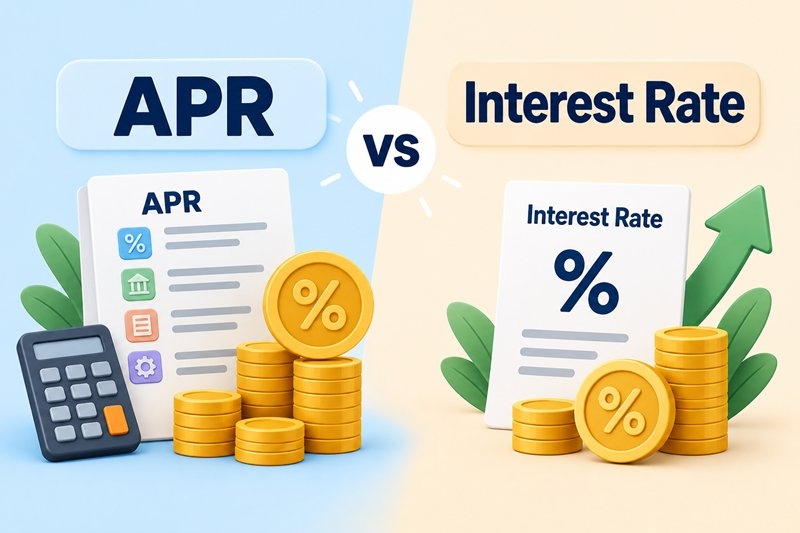
Looking at APR vs. interest rate comparisons can allow borrowers to analyze the details of the loan even further. In reality, APR vs. interest rate is the first thing borrowers tend to look for when agreeing to a loan.
However, there is a lot more to learn about this comparison so that you truly understand what you're paying.
The difference between APR and interest rate is explained below. To begin, it is important to understand what each rate describes.
The percentage a lender requires you to pay as a cost for using their money. Depending on the interest rate of your loan, it is used to reduce the amount of your payment that goes toward the interest.
For instance, if you borrow $ 10,000 with a seven percent rate, then interest is calculated on the balance, as well as the repayment schedule and the type of loan. The quote does not usually include the charges for the loan.
APR stands for annual percentage rate. APR is a more inclusive measure of the cost of borrowing that typically includes the rate and some other qualifying fees.
A loan can have a 7% interest rate but a higher APR because of an origination fee. The specific difference between APR and interest rate can be a result of the loan format, charge types, and calculation needs.
When comparing APR versus Interest rate, you need to see not only differences in the interest rate and estimate to be aware of the hidden costs that will include your borrowing and decide to choose financing that might be the best fit for your pocket. Here are the 5 differences between them.
An interest rate is the percentage that the lender is charging you for the loan and is used to compute the interest part of your payment.
In most cases, the APR (annual percentage rate) will reflect the annual cost of borrowing and include the interest rate as well as some additional loan costs, making it broader than the interest rate.
Interest rates solely examine the interest rate of the relevant money borrowed in such a loan. The interest rate quotes do not usually include separate fees in the loan prices listed in the rate.
APR, while including some items such as origination fees or finance costs in some cases, can be higher than the interest rate depending on the type of loan as well as the regulations that exist.
The interest rate helps consumers understand the loan's borrowing expense and to figure out the amount of interest they'd pay in case of loan terms.
On the other hand, the APR helps consumers compare the total cost of different credit offers when the interest rates and the charges are different. A loan with the lower interest rate but higher fees might present a higher APR than a different loan.
The interest rate is directly involved in determining the interest payment. A greater interest rate will result in greater interest on a loan, assuming all else is constant. The APR can include additional charges while reflecting some inclusion of interest in the loan and can include not only more derived interest but also other charges.
This means that your monthly payment will be caused by many factors like loan balance, the period of payment, interest rate, as well as the way your loan is structured.
Both allow you to know the expense of borrowing, while the interest rate gives you a view of the interest cost, and the APR gives you the total borrowing cost (in certain cases). Always compare the total cost of total payments, term lengths, total interest, fees, and monthly installments before taking out the loan.
When you learn "how is APR calculated", the fact that the interest rate is higher than the APR usually becomes obvious. You shouldn't add a percentage of the fees to the interest rate.
Our calculation takes into account the amount financed, any finance charges, the payment schedule, and the payment timing. Lenders have specific calculation formulas they use to determine covered credit products. The exact formula depends on the loan and required disclosures.
The APR displayed on your disclosure can be affected by;
A fee paid in advance can affect APR more when the repayment term is short. The annualized calculation will take into account the timing of the receipt of funds and the payments.
APR may be greater than the interest rate because it can include other fees that you may be able to have as part of your loan. The bigger the applicable fees and the shorter the repayment period, the larger the discrepancy.
What is the difference between options like these? Consider that with two lenders you have a loan that's quite similar. The one with the lower interest rates has greater origination costs; the other with the higher interest rates has fewer fees.
By price-only interest rate, you may miss some costs. Check the APR along with the interest rate to get more ideas about the deals.
When you're exploring financing options, both rates can play a part in your decision, and you should compare them to each other. Learn "What is APR vs. interest rate?" "Do you need both?"
APR makes it possible to compare offers that are similar in size and length of repayment, and in the frequency of payments. Provides a more extensive measure of annual cost, with some allowable fees included.
Say you're looking at auto loans; comparing the APRs on the different offerings can help you spot a variation. Also, pay attention to the length of the loan and other fees.
Here's why the interest rate is useful: Interest rates matter because it determines the amount of interest that you have to pay over the course of your loan agreement. The interest rate also plays a part in the scheduled installment payments (depending on the loan type).
For long-term loans, take a look at the rate of interest, whether it is adjustable, and the payment plan. These factors will give you a good idea of the expense of the loan.
A simple comparison of the lowest advertised rate isn't the only way to find the best deal. The full loan terms should be reviewed to see what your repayment obligations will be and what your costs will be.
Before accepting an offer, check:
The difference between the numbers does matter, since they don't say quite the same thing. If you see both, you will be better equipped to ask questions of your lenders.
Learning APR vs. interest rate gives you the info to make the best borrowing decisions. The interest rate is the amount you pay to borrow money, and the annual percentage rate (APR) typically includes the interest rate plus some fees on the loan.
Understanding what APR vs. interest rate is and how APR is calculated can help you analyze and compare loan disclosures and pricing offers. When comparing the APR and interest rate, compare both percentages, loan terms, and fees that apply. Know what the interest rate and APR are.
Not necessarily. APR can match the interest rate if no additional fees are involved in the calculation. The comparison depends on the type of loan and the rules for the calculation. Always look for the information being disclosed by the lender.
No, the payment amount depends upon the repayment structure of the loan and timetable. APR will be a factor in the loan amount, interest rate, and repayment structure.
APR varies with some open-ended credit products based on changes in the applicable rate. Fixed-rate products normally have a set, disclosed rate over the term of the loan. Be sure to read your document before you sign to find out.
The shorter you have a loan, the greater the annualized costs that go into the calculation. So, a modest fee can have a large annualized rate as you look at payments if you are covering the loan in the near future.
Not just with the APR. Depending on the loan structure, you should also be looking at the total amount you are borrowing, the monthly payment, the length of the loan, and the total payback amount you will pay back.
This content was created by AI